

What Sports Performance Means at Dynamic Health Carolinas
Sports performance usually means sprint times and strength numbers. Ours is a different job.
We have no dedicated training space and we sell no conditioning programs. If you want to add speed or add weight to the bar, a strength coach does that well, and we work alongside yours rather than replacing them.
What we assess is sequencing: whether the parts of your body fire in the right order, at the right moment, under load. A patient comes in reporting shoulder pain. The hip on that side is barely moving. The shoulder is where they feel it. It is rarely where it began.
The question we are built to answer is why, not just where it hurts. Our strength is helping patients understand what may be contributing to pain, limited movement, or recurring problems, especially when an injury has already been treated but symptoms have returned or never fully resolved. We look beyond the immediate discomfort to identify underlying factors that may be affecting recovery, movement, and performance.
Sports Injuries We Treat
Our sports injury treatment covers the full range of athletic and overuse injuries. The focus is on the ones that have proven stubborn.
- Lower back pain and disc-related pain, including pain that travels into the leg
- Mid and upper back pain that limits rotation, lifting or overhead work
- Neck pain, including post-collision and contact-sport injuries
- Shoulder pain, rotator cuff strain, impingement and throwing injuries
- Elbow pain and tendon overload from racquet sports, lifting and repetitive work
- Hip pain and glute pain that worsens with running, cycling or stairs
- Knee pain traced back to hip, ankle or gait mechanics
- Foot and ankle pain, including sprains that never settled
- Leg pain, numbness and weakness that needs a cause identified first
- Chronic pain lasting longer than three months
A mild sprain usually settles in about one to two weeks. Most straightforward fractures are immobilized for six to eight weeks and then heal. When something still hurts months later and imaging has ruled out damage that would explain it, the tissue is usually not the whole story. That is the point at which most of our sports injury patients arrive.
How We Find the Cause
Four assessments run in the same building, usually on the same day.
Who This Is For
For anyone with unresolved pain.
Whether you compete, train for fun, work a physical job, or just want to get through the day without pain, the assessment is the same.
- High school and college athletes carrying something from a previous season
- Runners, cyclists and triathletes whose symptoms return at the same point every time
- Golfers, tennis and pickleball players losing rotation, distance or reaction time
- Lifters and CrossFit athletes working around a joint they no longer trust
- Active adults who finished physical therapy and still do not feel right
- Anyone who has been told an old injury is simply permanent
- Anyone whose pain has never been fully explained
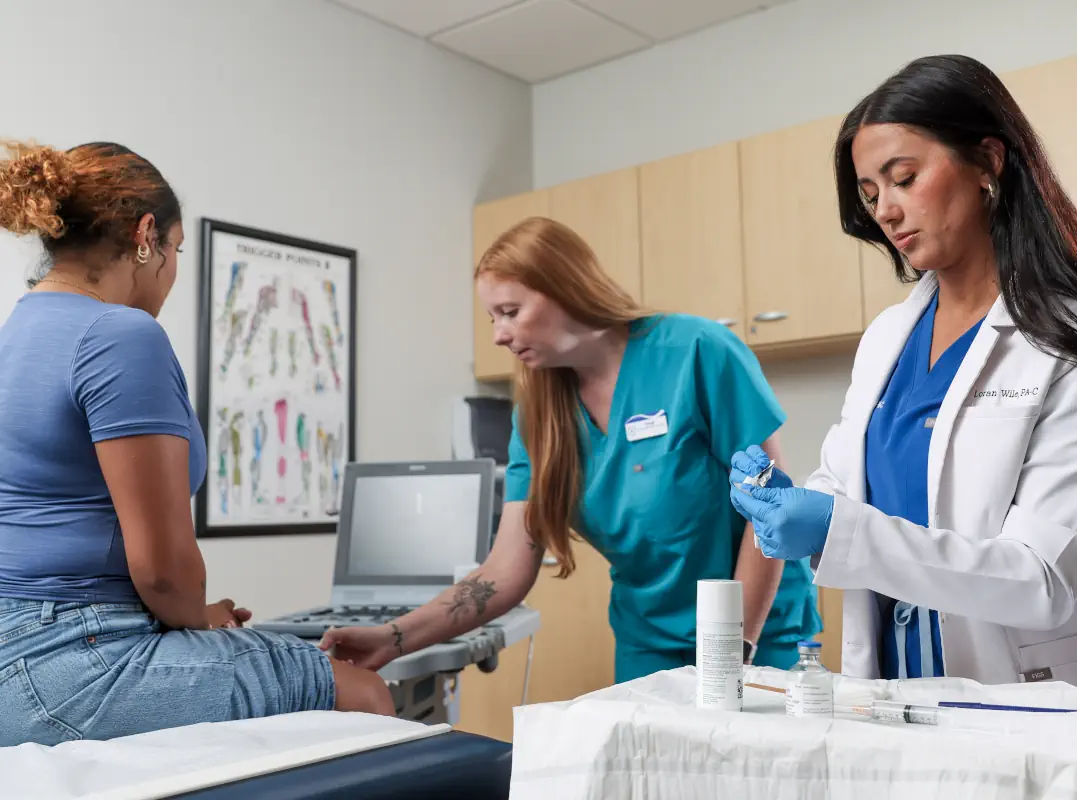
Our Whole-Body Approach to Sports Performance
Medicine is organized by area: a hand specialist, a knee specialist, a shoulder specialist. That works well for one clear problem. It works poorly when the cause sits somewhere other than the symptom.
A shoulder complaint can trace back to a nerve root in the neck. An ankle that will not settle can trace to the lower lumbar levels. When the source and the symptom sit in different places, a clinic organized around body parts keeps treating the wrong one.We assess the body as a single system: the nervous system, the muscles and ligaments, circulation, and the brain. Some clinicians use VR-assisted rehabilitation, which can help when the pain has gone but the movement still is not right.
The Sports Performance Team
Four chiropractors practice here alongside a board-certified neurologist, a nurse practitioner, a physician assistant and the rehabilitation team.
That combination is why a case nobody has been able to sort out tends to move here. When your assessment raises a question a hands-on exam cannot answer, the next step happens down the hall, on the same chart, with providers who talk to each other. You are not carrying your own notes between clinics.
Why Dynamic Health Carolinas
Most sports injury clinics in Charlotte are set up to treat the part that hurts. For a fresh injury that works well. We are set up around the question of what caused it.
- The diagnostics are in the building. When your case raises a question, it gets answered here rather than referred out and restarted somewhere else.
- One chart, one team. Chiropractic, medical and rehabilitation providers work from the same notes, so nothing gets lost between them.
- Assessment before treatment. We examine first and tell you what we found, including when the answer is that we are not the right fit.
- Built by an athlete. Our approach comes from Dr. Peter Cox, DC, who competed for the United States at the 1996 Olympic Games and built this clinic around the questions he needed answered as a competitor. He has also been sought out by organizations like the PGA and Sr. PGA tours, individual athletes and other medical professionals for his expertise in finding the cause of a problem and developing an approach to solve the problem.
Frequently Asked Questions
Come in and we will look at it together.
Some of this is much easier to show you than to explain in writing, with your own images and your own movement in front of you.
If something keeps coming back, or has not resolved the way it should have, that is worth an hour of your time. Tell us what happened and where it is stopping you, and we will give you a straight answer about what we are seeing.